Thank you for visiting my website. Very little here has been updated recently – a testimony to how busy (and happy!) I have been in my work, because this tiny corner of the internet was set up to showcase what I do and for potential employers to get some idea of how I write.
And yet here I am now, revisiting this site. At the time of writing this brief entry (February 2025) I am once again looking for new challenges. If you are a prospective employer, you will find a limited portfolio of regular news and business publications which will give you a flavour of my remit over the last 15 years or so, and a video or two of me on stage. For those, please see the buttons at the top of the homepage.
For confidentiality reasons, none of the business/market intelligence reports I have written/edited for HBI are here, and my work with Candesic consultancy is not included.
There are also some personal musings which may give some insight into what makes me tick, but my blog has been, at best, updated infrequently!
If you would like to see a copy of my CV please email me, and/or click below to see my LinkedIn.
Mum died last year. She was a remarkable woman, living in India in the foothills of the Himalayas in the shadow of Nanda Devi – and working – from her sixties to her late eighties. This was my eulogy to her. I have done a lot of public speaking over the years, but nothing as tough as this. I hope I did her justice.
Do you care where you get your news from? And does it matter?
We used to be satisfied when we picked up our daily diet of news – up to a day late – in stodgy broadsheet format or saucy, bite-sized red top flavour.
And we all knew a journalist when we met one. They were hard-drinking, thrice divorced cigarette smoking ne’ er do wells who would sell their grandmothers for a scoop.
But now we’re all journalists, potentially. Citizen journalists. Every mobile phone and tablet gives its owner the potential to capture news as it happens, and serve it up to a willing audience on a Twitter or blog-shaped plate, or on any number of hyper-local sites.
But there is a risk, in this world where everyone is publishing everything they see and commenting on it, that news sites will become little more than a showcase for “content harvesters”, regurgitated stories culled from the internet and written by others, repackaged at low-cost by bleary-eyed battery-farms of sunshine-starved “journos-lite” for easy consumption.
In any event, I’d like to hope some of the reading public still has an an appetite for real journalism. Because someone has to hold those in power to account, rather than simply accept what they say. Someone needs to keep an eye on what is happening in our courts. Someone needs to do some actual investigation.
I’m not sure, yet, to what degree that is the case, but it does please me to see that, when looking at my former papers’ daily web figures, there is clearly still an appetite for proper, strong news values. Good, original stories are still well read and commented on.
Slightly less palatable to me is that there is often an even greater appetite for celebrity, or frothier pieces, on occasion. But the canny editor and journalist gives his readers both and you can only hope, consciously or otherwise, the public appreciates the full breadth of what they are getting. Because there’s no harm in enjoying a pudding with your meal, as long as you’re getting the main course too.
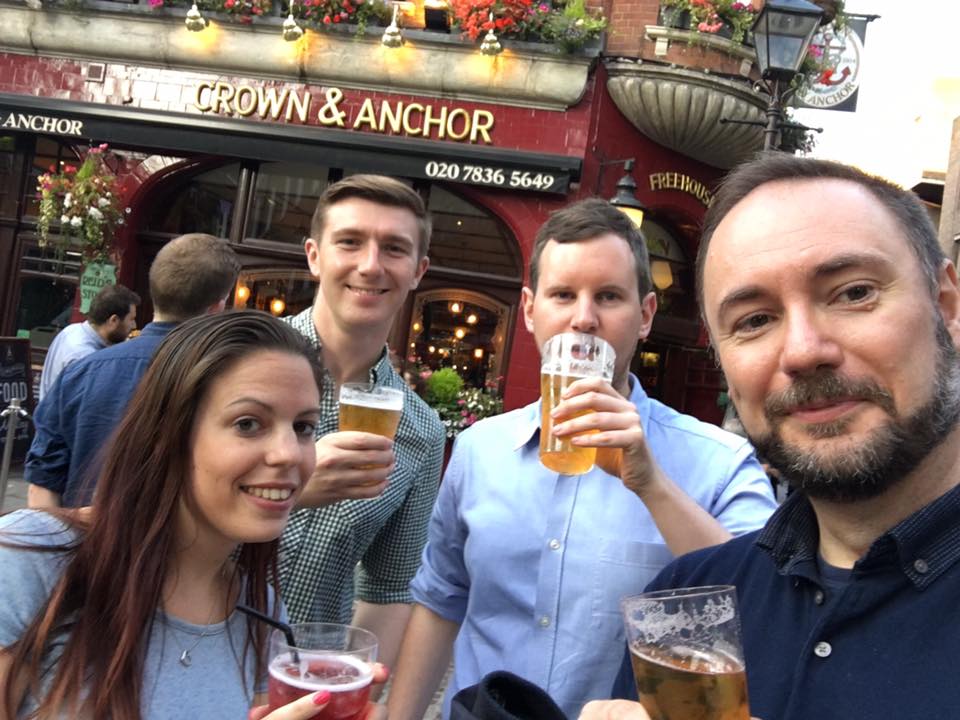
Pre Xmas drink with former newsdesk colleagues, December 2017
In August of 2016, I made what was quite possibly the hardest professional decision of my life. I walked away from local journalism, for the moment at least.
The inexorable decline of the profession, and the cynical way in which those presiding over the dismantling of the papers I had invested so much of my time in to keep afloat were acting, made the decision easier than it ought to have been.
Things were still so different back in 2007 when, as a trainee, I joined the troops on the frontlines of the award-winning Surrey Mirror newsdesk. Back then, there was one team per paper. Every paper had an editor. Reporters had patches. All something today’s trainees, chained to their desks and with a brief to pen articles designed to garner clicks rather than breaking real news, can only dream of.
Based in Reigate (and thereafter, for a while, in Redhill) my office was, crucially, on patch. If there was a story, you were seldom more than 5 minutes away by car, and usually it was within walking distance. In Reigate, the sub-editors laying out our pages were local and new the patch as well, if not better than their (usually younger) news desk compatriots.
They could spot errors because they were familiar with the area and they took a pride in the few papers they worked on because they were their papers too. And if you got something wrong, there was a walk of shame to the subs desk to explain yourself.
Fast forward to my leaving and beyond, to late 2017 when last I caught up with some of my former colleagues, most of whom have moved on, and things are so very different.
What is left of my first paper, the Reigate / Redhill centric Surrey Mirror, is now produced by reporters in Guildford at least 30 minutes away. Good luck getting to a breaking news story while it’s still breaking. Reporters often work from home, or face huge journeys to both get into the office, or back onto patch.
And my other papers? The East Grinstead Courier, which was winning awards / award nominations for its reporters back when I was chief reporting then editing is now little more than a collection of out of patch stories culled from a Kent sister paper, with a few change pages.
And the Crawley News? Folded. They even killed the website, destroying years of online history, not that the staff knew in advance this was planned. I’m told they turned up to work, and it was gone.
As for the teams, these have been decimated too. Reporters who once had a patch within a paper were told, after reapplying for their jobs and facing redundancy, that they would be working an all the papers in a central hub. And working shifts. Including evenings and weekends. Pages are subbed scores of miles from their readers, by people who have never visited the towns that feature on them, let alone lived there.
Back in 2007, I joined the Surrey Mirror at the beginning of the end of local papers. First question I asked was “where’s the fire?”. Turns out it was under the profession.
I’m not a massive rollercoaster fan. I once insisted my brother-in-law buy me a Rock ‘n’ Rollercoaster cap after the Disney Aerosmith ride, contrary to all pre-ride promises, performed several vomit inducing loops.
We’ve just concluded our 2017 conference at work. The feeling of exhilaration I feel now is much the same as when I got off that ride.
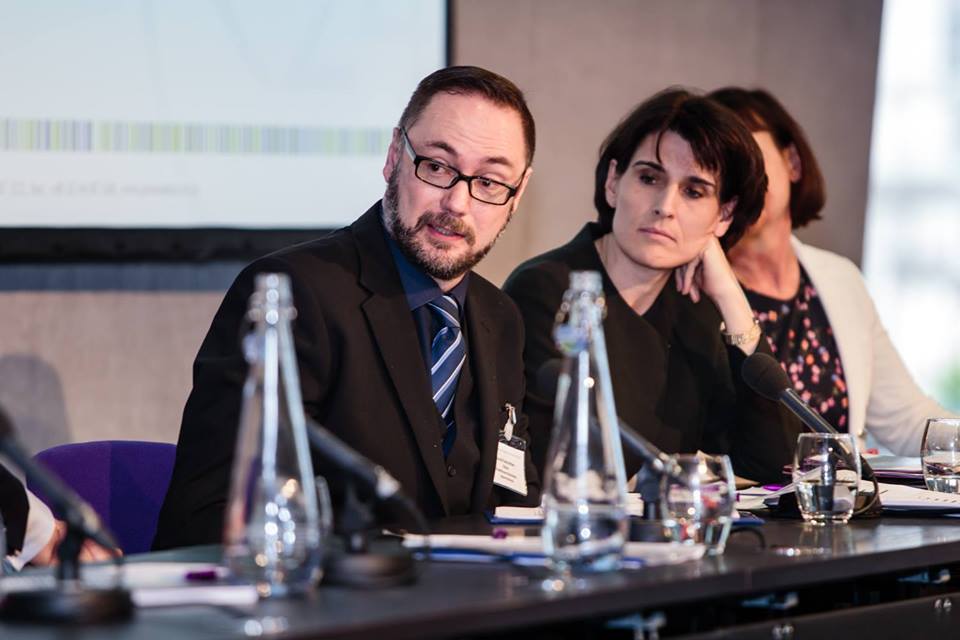
My company organises the biggest CEO-level healthcare conference in the world, I’m told. It took place this year in the QEII Centre, a stone’s throw from Parliament. It was a spectacular venue, with amazing views of the capital, but I didn’t really get the chance to take them in as I chaired four of the panels and schmoozed and networked my way through both days from 8 till very late.
In many ways the prep was harder work than the event. I’m happy on a stage. Give me a microphone and an audience of any size and I’ll happily chat. Or sing. I have memories of giving a near flawless performance of Careless Whisper at a Skegness pub in 1998 but my recollections may be skewed by the 6 or 7 pints I’d consumed that evening, and my subsequent victory in a limited, mixed ability field was assured by having weighted the audience in my favour in advance. I’m as good as teatotal these days barring Christmas parties but back in the day, especially during the wayward period when I was running my own business, I didn’t really see any barriers in life.
But back to the conference. I spent weeks, on and off, outside of office hours, making myself an expert in digital health, central and eastern Europe, elderly care, and MENA (Middle East and North Africa).
I’ve never shied away from asking difficult questions and this conference was no exception. I loved it – see for yourself:
For the hour or three while I was on those stages, I had my briefs mastered! Just don’t ask me anything about them! In fact, don’t ask me anything for the next two weeks. Now I’ve got to write it all up.
Sometimes, reporters get to see extraordinary things. And we get to talk to people in extraordinary situations. We get to see people at their moment of triumph, and at their lowest ebb.
I’ve done a dozen ‘death-knocks’.
When someone dies before their time, you can’t ignore it. There’s a clear public interest usually in finding out what happened – and learning whatever we can to make sure it doesn’t happen again.
There’s an editor’s code to make sure any and all reporting is done the right way and it’s possible to breach that code in a number of ways when covering someone’s death so reporters and editors should always tread very carefully. I certainly do.
It’s usual for a reporter to be dispatched to see if the friends and relatives want to talk. It’s not something many relish. It’s something many dread. What can you possibly say to someone who has lost a loved one?
You might expect that people in that situation would react to a stranger turning up on their doorstep with anger.
You see complaints in the national press about media scrums, and press intrusion, when someone famous dies.
In my experience, that’s almost never the case at a local level.
If people don’t want to say anything, they only need to say it once, and we walk away.
But generally, they do want to talk. They want to share memories. They want their loved ones to be remembered.
I’ve never, not even once, had complaints about asking someone if they want to talk. Only once has someone reacted with any degree of anger. The only complaints I’ve had are from friends and family saying “why didn’t you talk to us?”
The answer, usually, is because we didn’t know how to contact them. And if we’re told by the family – through the correct channels – not to call in advance, we don’t.
I wonder, occasionally, how I might react if something happened to one of my my nearest and dearest.
I think I’d want to celebrate their life. I’d want to scream their name from the rooftop. Plaster their beautiful photo on every billboard. I can’t be sure. Can you?
I do know I’d want to be asked. Not see something written without my having the chance to say something.
So I’m so grateful to everyone who spoke to me at such an awful time. Not because they gave me a story. But because they briefly let me into their lives and shared an extraordinary, horrible, moment with me.
One crisp winter’s evening in 2008, as temperatures plummeted to their lowest average in 10 years (a figure only a meteorologist or local journalist is likely to know) I found myself strolling home in my shirtsleeves looking at a purple polka-dotted sky and thinking, you know, David, something isn’t quite right.
As the sleet failed to settle around me, I noted I was unusually warm. On and off I had been getting ‘visual aberrations’ for years without really paying them much heed. It’s hard to look directly at something that’s only ever in the corner of your eye. Suddenly, these flashing disks were too large to ignore.
Christmas loomed, and I lost my appetite. Completely. The doctors were mystified. There were blood tests, and I was poked and prodded and bits of me were squeezed quite hard by a nice lady doctor with very cold hands.
Eventually, she worked out that like my father, and his father before him, I’m diabetic. Because I’d stopped eating my blood sugar levels had dropped and that had made it harder to detect.
It’s hard to explain how the tablets helped. Readers over a certain age will remember when televisions took two people to carry and looked like squashed steampunk armoires. Imagine turning all the little knobs on the front of one of those sets up, volume, brightnes, contrast. That’s how I saw the world.
And then suddenly the meds kicked in, and the world was a quieter, duller place. As, perhaps, was I. It’s impossible for me to know. Some of the decisions I made before my diagnosis were as colourful as my then view of the world. That, however, is best left for another post.
As for my health, ironically, it’s now better than ever. My sugars are low. My weight is down. I take a couple of tablets a day, and all is well.
I applied for two jobs recently. I got two interviews. I was offered both jobs. I know, saying that seems a tad boastful.
I like interviews. I see them as a bit of a blind date, though that view is perhaps coloured by the fact I’ve never been on a blind date. It’s not all about interviewers grilling me, though of course they must. I want to know why I’d be a good fit for the interviewing company and why I should join them too.
One of the best trainees I ever took on asked as many questions as I did. He even put me on the back foot slightly when I feigned an interest in football which, in practice, died around 1996. To be fair, that Gazza goal against Scotland, especially for a Geordie fan, was always going to be hard to top.
And when I’m in the other chair? It’s not that I don’t want to impress. But when it comes to being a journalist, and encouraging others to excel, I know I’m pretty good at it. And I really enjoy it. As Confucius apparently never said, “Choose a job you love, and you will never have to work a day in your life.”
I can’t go that far. I’ve certainly been working, but it’s far easier to do well at something you love. It makes you good at it and that gives you a sense of pride. Working anything up to a 60-hour week with little or no recognition or thanks, dwindling staff, and few prospects under my present employer has shattered the lenses in my rose-tinted spectacles.
I chanced my arm and spoke to the boss of my boss’ boss and despite the fact that I had a couple of jobs lined up, I was offered a generous redundancy package.
And now I’ve taken a gamble. A bigger gamble than I expected to take given that I had a safe option already lined up. I last took a gamble this big in the late 1990s when I thought setting up my own business was a spiffing idea. That cost me £10,000. And my first marriage, at least in part.
I could be looking forward to editing a privately-funded independent local paper in an affluent town. That would be the easy option and require zero prep.
Instead I’m reading a weighty tome entitled “Show me the money” and trying to learn what EBITDAs and price-earnings ratios are, as I’m set to edit a healthcare publication specialising in the buying and selling of businesses, CEO interviews and the like.
There’s some smart business graduates at this place. I’m going to teach them how to be journalists. They’re going to help me become financially savvy. I’ve been frank about my strengths and my current shortcomings for this post. But the business model is impressive (I’ve seen, and re-written the business plan. I wasn’t asked to I just thought I’d offer my thoughts!) and this is clearly a company going places.
Wish me luck. Hopefully hard work will be enough. For the chance to better secure my family’s financial future, I’m going to give this my best shot.
It’s Father’s Day fairly soon. I’ve started getting emails asking me to consider relevant content for both the paper and online. And so my thoughts have turned to my dad.
He died four years ago, but it took another 18 months for me to find out. No one told me. My mum got a letter from HM Revenue & Customs which casually confirmed Dad’s death – and she told me.
When we contacted the undertakers which handled the funeral to find out more, they said he didn’t have any next of kin. He did, they just walked away from him a long time ago, and never looked back. Well, I never looked back until it was too late.
I tried to find out where Dad’s ashes were scattered so at least I’d have somewhere to belatedly pay my respects, but the friends who scattered them, eventually as they lay unclaimed for months it seems, didn’t want to talk to me.
I don’t know the man he became before he died. In the two decades after I walked away, we had no contact save a letter that turned up at my place of work saying we should talk, and he was sorry for what he did. But I know the man George Alexander Farbrother was with me, and my mum. He was a bully.
I used to be so angry about that. And while there was little I could do about his behaviour when I was younger, by the time I was 16 I was a strapping 6ft 1in and 14 stone rugby player, and more than capable of pushing him back, which I did.
I wonder, sometimes, if it was at least in part my fault he behaved the way he did. I was a kid with a smart mouth who questioned everything, because I wanted to understand everything. And I’ve always liked playing with words and never been frightened to disagree with someone if I think they are wrong. I was the smart-mouthed product of a private school, he was a football loving bloke who worked on the quayside. I’m too old to know everything now, but back then…
And I wonder whether I did the right thing cutting him out of my life so abruptly and completely. He had no contact with my family. I didn’t want him near my wife, or my daughter.
But now he’s gone, there’s a hole in my life I never expected. We weren’t in touch, and I hated the way he behaved towards me and Mum. But I always knew he was out there, somewhere. Most likely in the little three up, two down near Newcastle where I grew up. And that was always a comfort. There was always a chance – and in my mind a likelihood – of reconciliation.
Because, over what were to prove to be the final years of his life, there were a number of times when I came close to calling him. And now I never can. I suspect that will always be one of my biggest regrets.
I wish I had. I’d imagined we’d sit, and have a pint at the Benedictine, the working men’s club he liked to go to. And we’d agree we saw the world differently, but I was never going to have another dad, and I was his only son.
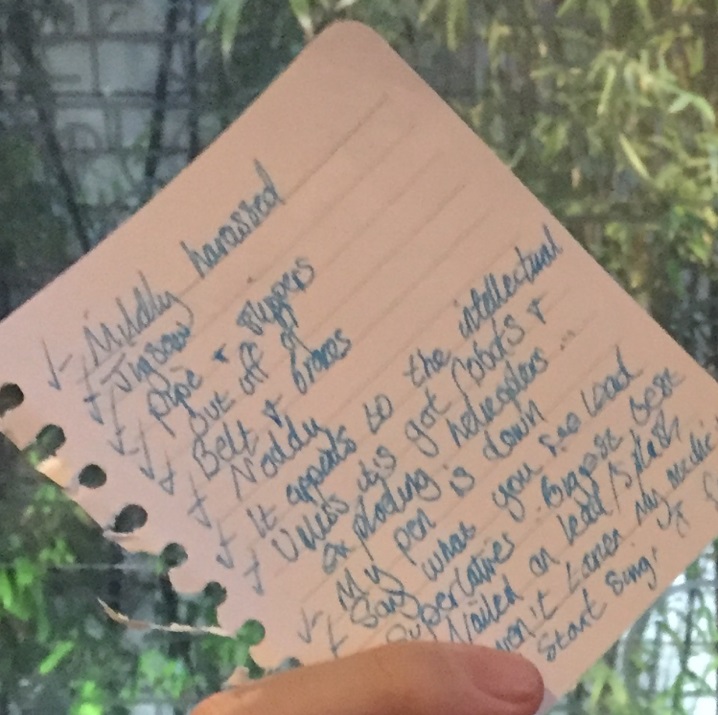
But at a recent works meal out, we played a game of what I’m going to call ‘David Bingo’.
The team were asked by one of the other content editors to write down four of my oft-used phrases and sayings, and then he called some out bingo style until someone shouted house. Disappointingly, I didn’t win.
But here, for your edification, are a selection of those phrases which the team allege I use quite a lot, together with their real meaning!
I’m mildly harassed
I’m on deadline.
I’ve got my pipe out and slippers on.
I’m off deadline.
You know how putting together a newspaper is a lot like putting together a jigsaw?
You’ve not given me the right pieces. More news in brief pieces needed!
Belt and braces.
Let’s play this one safe. We don’t want to be caught with our pants down. And at the moment, you may get us sued.
It appeals to the intellectual, the sensitive, the artistic.
I like it, and you don’t, then.
My pen is down.
This conversation is off the record.
My pen is poised.
We’re on the record.
It’s a say what you see lead.
If it takes you more than an hour to write this story, you’re taking too long!



 Musings of a jobbing journo